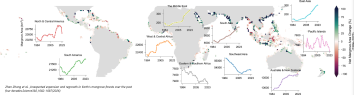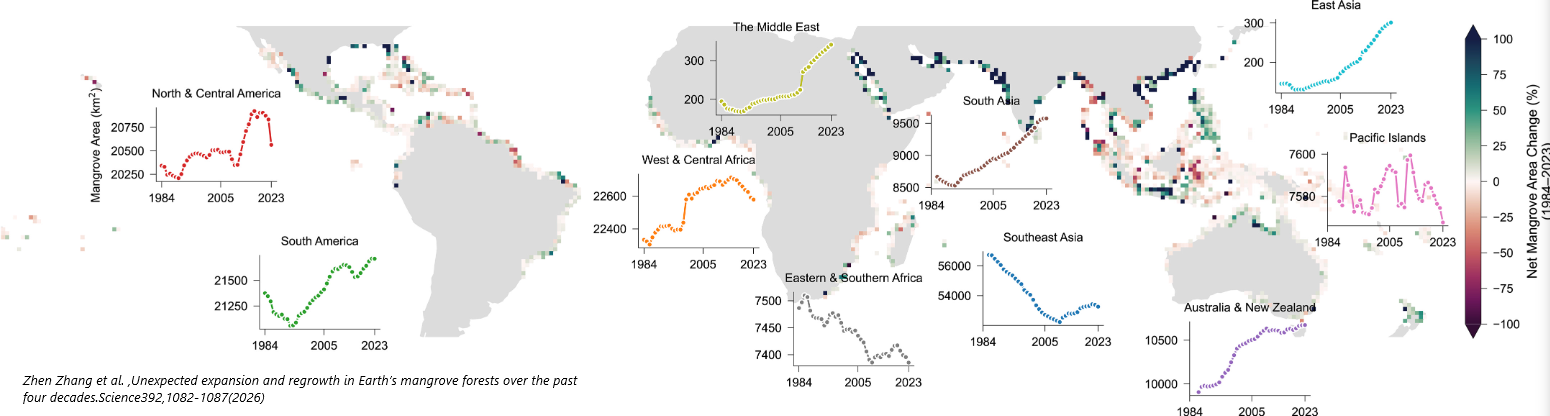
Mangrove forests are coastal habitats that serve as nurseries for economically important fisheries. Natural disturbances such as cyclones and shore erosion, together with aquaculture, palm plantation, and rice paddy expansion, have led to global declines in mangrove forest cover, spurring national and international pledges to restore it. Zhang et al. created a 30-meter-resolution annual dataset from satellite imagery to assess how mangrove occurrence and canopy cover have changed from 1984 to 2023. Mangroves declined globally before 2010, but have mostly recovered since then, with both forest loss and degradation (declining canopy cover) rates slowing over time. Mangroves are mostly expanding into new habitats, but also regenerating in former habitat, suggesting hope for ecosystem recovery.