  • SPREP Home
  • Protected Areas
SPREP Home
Log in
Search
Home | PIPAP - Supporting the sustainable management of protected areas in the Pacific Region.
  • Data
    • Protected Areas
    • Management Effectiveness Dashboard
    • Spatial Data
  • Assistance
    • How SPREP Helps
    • WDPA Protected Area Registration
    • Protected Area Working Group
  • Resource Hub
    • Publications
    • Decision Making Support Tools
    • Case Studies
  • Newsletter
    • Browse Newsletter Archive
    • Subscribe Now
  • Account
    • Login

Main menu

  • Data
  • Assistance
  • Resource Hub
  • Newsletter
  • Account

Breadcrumb

  1. Home
  2. Resource Hub
  3. Publications

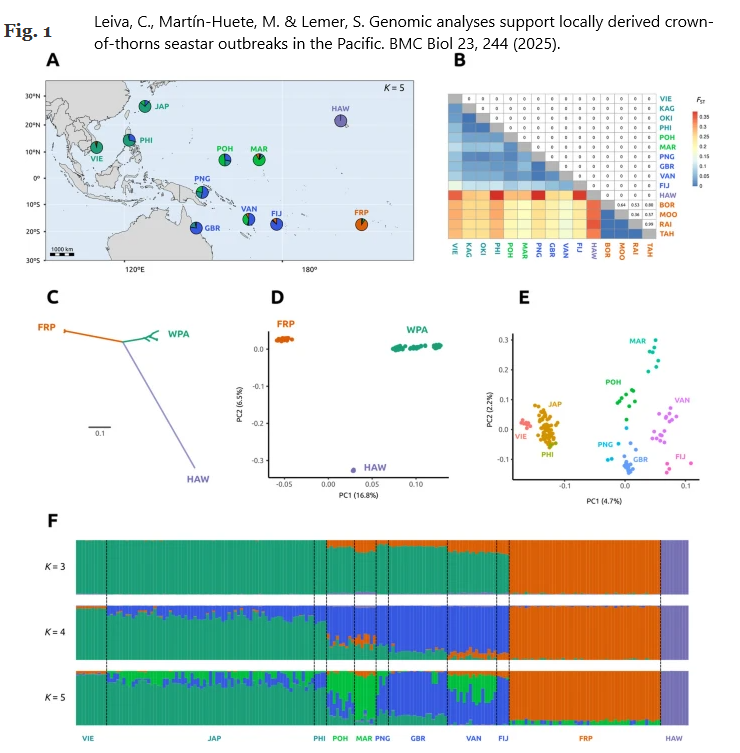
Genomic analyses support locally derived crown-of-thorns seastar outbreaks in the Pacific

Crown-of-thorns seastars (COTS, Acanthaster spp.) are the most notorious coral predators, whose devastating outbreaks cause recurrent and extensive coral depletion across Indo-Pacific reefs. However, the spread potential of COTS outbreaks and the anthropogenic role in their initiation have remained a subject of intense debate for over five decades.

Learn more

Leiva, C., Martín-Huete, M. & Lemer, S. Genomic analyses support locally derived crown-of-thorns seastar outbreaks in the Pacific. BMC Biol 23, 244 (2025).
Links
https://bmcbiol.biomedcentral.com/articles/10.1186/s12915-025-02350-4#citeas
Publication
Related page category(s)
Management
Thematic Area
Opportunities
Pacific Protected Areas
Related Pages
Don’t just plant trees, plant forests to restore biodiversity for the future
Drone imaging can accurately assess coral cover, bleaching, and growth form for shallow coral reefs
Coral reefs at a crossroads
Half of seabirds are declining. Protecting marine flyways could help save them
Biodiversity resilience in a tropical rainforest
Forest loss persists despite certification and protection
Afforestation and reforestation have varying biodiversity impacts across and within biomes
What ‘paper parks’ reveal about the limits of conservation policy (commentary)
The Global Deep Sea Exploration Goals: A representative approach to visually observing the deep seafloor
A global butterfly index could advance insect conservation worldwide

Latest News

IUCN-ORO
Project Procurement and Finance Officer, Kiwa Local Projects Component A
April 24, 2026 by Isaac Rounds
Read More
Fiji
Fiji Strengthens Environmental Governance as New Law Takes Effect
April 23, 2026 by Isaac Rounds
Read More
Fiji
Fiji pushes to turn biodiversity policy into real action
April 23, 2026 by Isaac Rounds
Read More
Samoa
Samoa-Community rangers network launched
April 23, 2026 by Isaac Rounds
Read More

Latest Resources

Life on the Pacific Reefs
April 26, 2026 by pipap.sprep.org
Read More
Tuki and the Turtle! (Video)
April 26, 2026 by pipap.sprep.org
Read More
Year of The Coral Reef: Ungil eleched, a ungil klengar, Palau
April 26, 2026 by pipap.sprep.org
Read More
Don’t just plant trees, plant forests to restore biodiversity for the…
April 22, 2026 by Isaac Rounds
Read More
Biodiversity and Protected Areas Management Programme Logo Organisation of African, Caribbean and Pacific States Logo Sprep BioScapes Logo Flag of European Union International Union for Conservation of Nature Logo European Commission Logo

SPREP Footer Logo

A resilient Pacific environment sustaining our livelihoods and natural heritage in harmony with our cultures.

+685 21929
sprep@sprep.org

  • SPREP on Facebook
  • SPREP on YouTube
  • SPREP on Twitter
Protected Areas by Country
  • American Samoa
  • Cook Islands
  • Fiji
  • French Polynesia
  • Guam
  • Kiribati
  • Marshall Islands
  • Micronesia (Federated States of)
  • Nauru
  • New Caledonia
  • Niue
  • Northern Mariana Islands
  • Palau
  • Papua New Guinea
  • Samoa
  • Solomon Islands
  • Timor-Leste
  • Tokelau
  • Tonga
  • Tuvalu
  • Vanuatu
  • Wallis and Futuna
SPREP © 2026. All rights reserved.