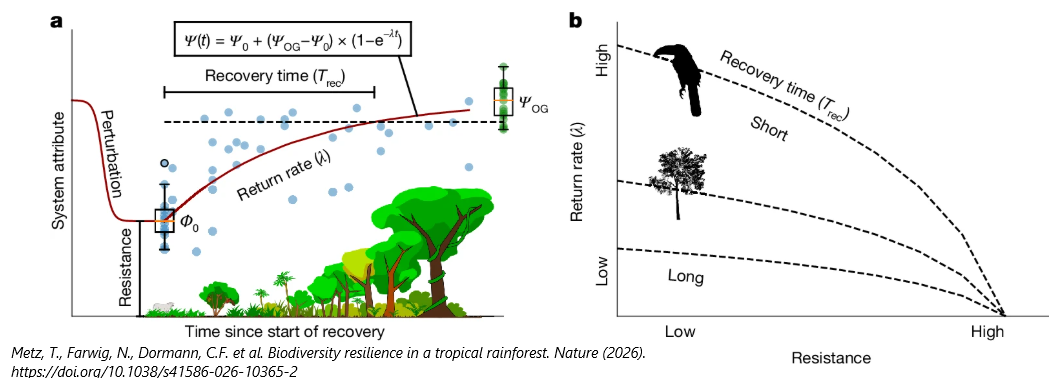
The UN Decade on Ecosystem Restoration aims to stop biodiversity losses1. Approximately 60% of tropical forests have already been lost or severely degraded2, making restoration essential to achieve conservation goals. Recovery trajectories of trees have been studied intensively3,4, but a comprehensive understanding of biodiversity recovery is lacking. Here we analyse recovery trajectories across trophic levels including 16 taxonomic groups from three kingdoms in a lowland tropical forest by investigating resistance to perturbation, recovery times and return rates to old-growth forest conditions. Abundance and diversity regained more than 90% and composition approximately 75% similarity to old-growth forests within 30 years, but full recovery takes several decades. Mobile animal communities acting as seed dispersers or pollinators had high resistance levels and recovered faster than trees or tree seedlings. Return rates contributed 1–2.5 times more than resistance to the recovery times of species composition. Taxon-specific recovery times could not be explained by simple mechanisms (life-history strategies, trophic level or mobility). We show the enormous potential of protecting naturally recovering secondary forests to stop and reverse biodiversity losses.