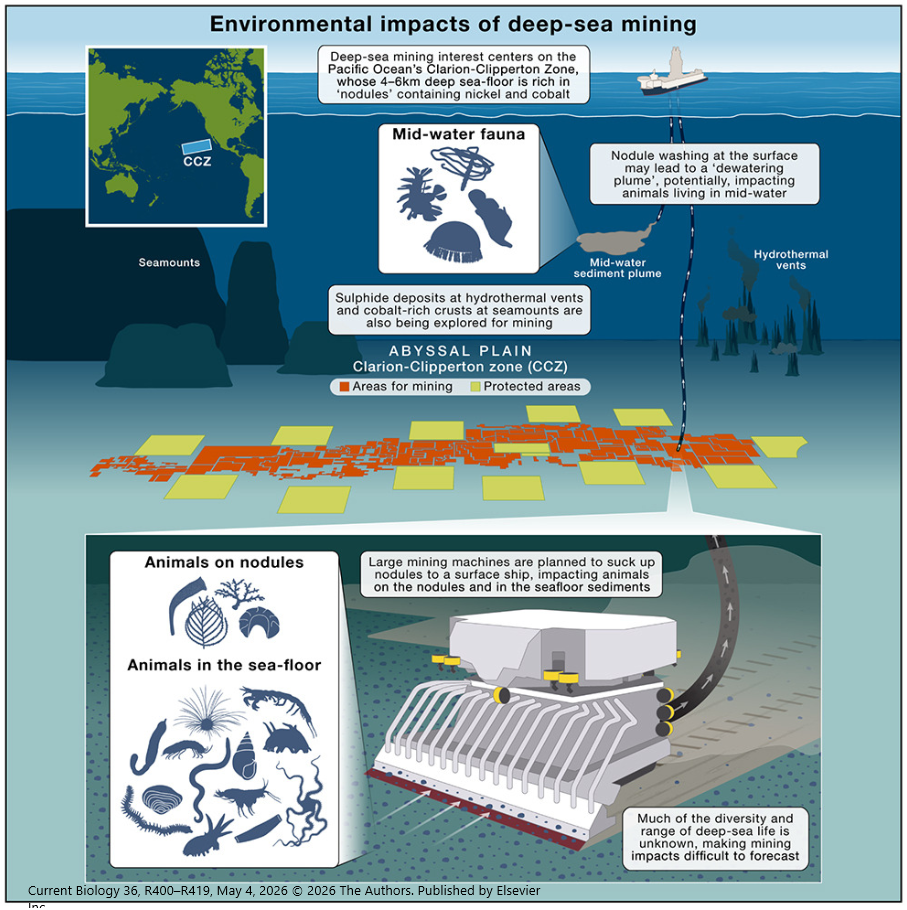
The deep sea contains a wealth of potential mineral resources, many of which are being investigated for commercial exploitation. Exploration and technical tests started in the late 1970s with an initial focus on polymetallic nodules from an abyssal region in the eastern Pacific Ocean called the Clarion-Clipperton Zone (CCZ). More recently, exploration has commenced at seafloor massive sulphides (formed by hydrothermal vents) and seamounts (for cobalt-rich crusts). Here we review the many decades of environmental research in these areas with a focus on the biodiversity baseline and the results from experimental mining or disturbance tests. Data from the CCZ have revealed that the seafloor is biodiverse, albeit at low biomass. For nodule mining, geophysical and biological impacts are persistent over at least multiple decades, although some dominant animal groups show successional recolonisation. By contrast, exploration for minerals at sulphide deposits and seamounts has been quite limited, empirical data on recovery timescales are lacking and these systems are likely to respond differently to disturbance. Deep-sea mining in any habitat could potentially generate plumes from ore dewatering which may affect pelagic ecosystems depending on the technology used. For all types of deep-sea mining, we distinguish ecological resilience and recovery from the risk of biodiversity loss (species extinction). Taxonomic data based on collections are critical to this debate; for abyssal fauna we can only currently hypothesise species ranges based on habitat availability. For vents, and to some degree seamounts, there is clear evidence that biodiversity loss from deep-sea mining is likely. If these sites were to be classified as areas of ‘high biodiversity importance' under the Convention on Biological Diversity, deep-sea mining at them would not be scientifically compatible with existing policy.