Human rights matter for marine conservation because people and nature are inextricably linked. A thriving planet cannot be one that contains widespread human suffering or stifles human potential and a thriving humanity cannot exist on a dying planet.
Information on the location of known seabird breeding colonies throughout the Pacific including all PICTS, also Hawaii, Australian offshore islands and NZ Kermadecs As of 2025 this database is now available online at http
Every year, the amount of plastic waste entering aquatic ecosystems is estimated between 9-14 million tons and this projection could nearly triple to 23-37 million tons per year by 2040.
The intersection of potential global targets and commitments for ocean conservation with the COVID-19 pandemic in 2020 has resulted in an opportunity to rethink the future of marine area-based conservation tools, particularly for marine protected and conserved areas (MPCAs).
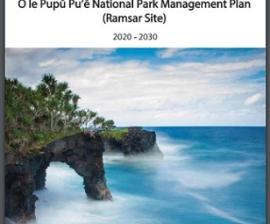
O Le Pupu-Pu'e National Park was the first Park established in Samoa at a time when the environment movement and concerns for our unique biodiversity and natural features was still only a passing thought.
Human rights matter for marine conservation because people and nature are inextricably linked. A thriving planet cannot be one that contains widespread human suffering or stifles human potential; and a thriving humanity cannot exist on a dying planet.
Protected areas (PAs) are essential for biodiversity conservation but are threatened by cropland expansion. Recent studies have only reported global cropland expansion in large PAs between 1990 and 2005.
Eight percent of all land surface has been designated as “Key Biodiversity Areas” (KBAs). Since these areas were established based on two percent of all terrestrial species estimated to exist, we ask what would happen if we used all species on Earth to identify additional KBAs.