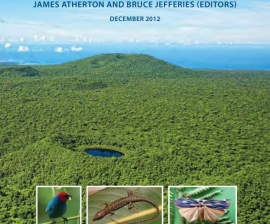
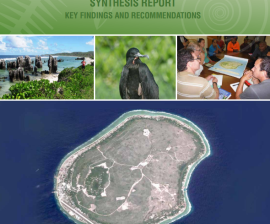
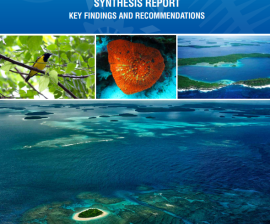
This report presents the results of the 2016 Funafuti Community-Based Ridge-to-Reef (R2R) Rapid Biodiversity Assessment (BIORAP) of biodiversity and ecosystem services (BES), hereafter referred to as the BIORAP.
A Biological Rapid Assessment Program (BIORAP) was conducted from July 16 to August 3, 2016 in three Key Biodiversity Areas (KBAs) in Samoa: the Central Savai’i Rainforest KBA, and the Falealupo Peninsula Coastal Rainforest KBA on Savaii; and the Uafato-Tiavea Coastal Rainforest KBA on Upolu.
The Biological Rapid Assessment Programme (BIORAP) is a biological survey based on a concept developed by Conservation International and designed to use scientific information to catalyse conservation action.
SPREP presents these guidelines for undertaking rapid biodiversity assessments in its Pacific island member countries and territories: Micronesia, Melanesia, and Polynesia. These assessments are referred to as BIORAPs.
his BIORAP (Biological Rapid Assessment Program) survey was undertaken as part of the process to facilitate improved management of the forests and biodiversity of Upland Savaii.
A BIORAP is a biological inventory programme undertaken in marine and terrestrial environments, and is designed to rapidly assess the biodiversity of highly diverse areas.
The purpose of the Nauru BIORAP was to improve the state of knowledge of marine and terrestrial ecosystems, to provide a scientific basis for the conservation and management of nationally, regionally and globally important ecosystems and species.
A BIORAP is a biological inventory programme undertaken in marine and terrestrial environments, and is designed to rapidly assess the biodiversity of highly diverse areas.
This Pacific Islands Framework for Nature Conservation and Protected Areas 2021-2025 is the principal regional strategy document for environmental conservation in the Pacific.
The ecosystem and socio-economic resilience analysis and mapping (ESRAM) is a baseline study to identify vulnerabilities in ecosystem services at national, provincial and community scales in Fiji.