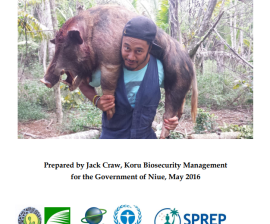
Feral and wandering domestic pigs collectively cause significant environmental damage in Niue, chiefly to coconut crab populations, seedling coconuts, soil organisms, soil structure and fertility transfer. They also cause significant economic damage to plantations and domestic gardens.
These Guidelines deal with invasive plants, animals, disease agents and other organisms, in marine, freshwater and terrestrial environments, and their impacts on the environment, biodiversity, ecosystem services, human health, economies and society.
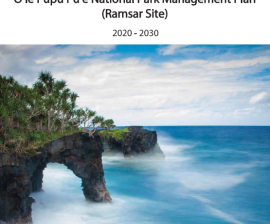
A Management Plan for the O Le Pupu-Pu'e National park was first formulated in 1981 and has not been revised since then. Circumstances for park management have changed significantly and some sections of the Management plan are now out of date.
This management plan seeks to enhance the ecological value and resilience of terrestrial, freshwater, estuarine, coastal and marine ecosystems in the District of Nadi and adjacent coastal waters.
The purpose of this management plan is to set objectives and policies that will guide the Park Management with its implementation programs in accordance with the Lands, Survey and Environment Act 1989, Section 116.
This document provides practical guidance on developing management plans for Protected Areas (PA). It is generic in nature and so applicable to Pacific Islands and other regions of the world.
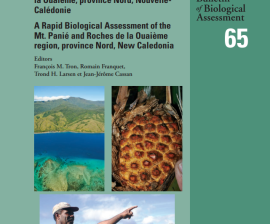
The Mt. Panié RAP survey was led by a partnership between local communities, Province nord (Northern Province), Conservation International (CI) and Dayu Biik, an indigenous conservation non-profit organization. CI and Province nord’s relationships
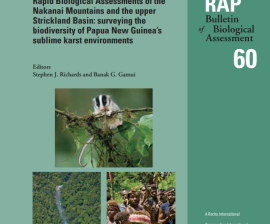
The independent state of Papua New Guinea (PNG) occupies the eastern half of New Guinea, the world’s largest and highest tropical island and one of the last major tropical wilderness areas on earth.
Conservation International’s Rapid Assessment Program (RAP) is an innovative biological inventory program designed to use scientific information to catalyze conservation action.
The Republic of Fiji consists of approximately 300 islands located roughly 3000 km east of Australia in the Pacific Ocean (between 16o and 20oS, 177oW and 175oE). There are four main islands in the Fiji group: Viti Levu, Vanua Levu, Taveuni and Kadavu.