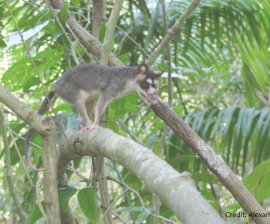
When night falls in Panama's forests, the time of the opossums begins. The marsupials, which have spent the day sleeping in trees, climb down the trunks and search for fruit, frogs or eggs on the ground. The omnivores often carry a hazardous parasite—the Chagas disease pathogen.
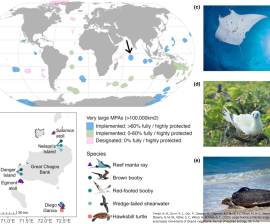
Global calls for greater ocean protection have sparked renewed interest in very large marine protected areas (VLMPAs, >100,000 km2) to achieve management targets; however, their conservation value is debated.
Crown-of-thorns seastars (COTS, Acanthaster spp.) are the most notorious coral predators, whose devastating outbreaks cause recurrent and extensive coral depletion across Indo-Pacific reefs.
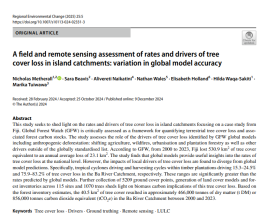
This study seeks to shed light on the rates and drivers of tree cover loss in island catchments focusing on a case study from Fiji. Global Forest Watch (GFW) is critically assessed as a framework for quantifying terrestrial tree cover loss and associated forest carbon stocks.
The Blue Carbon Finance Toolbox aims to provide the global blue carbon community with an overall guide to understanding and leveraging finance mechanisms that
If the ocean was a state of its own, it would be the seventh largest economy in the world – with a “gross marine product” of at least US$ 2.5 trillion per year. This Blue Economy is underpinned by diverse ecosystems that provide valuable services to the world, be it fishing, tourism or shipping.
mo e ngaahi Feitu’u Pule’i Makehe pe Special Management Areas (SMA). Ko e kaveinga, ke fai ha ako mo ha fevahevahe’aki fekau’aki mo hono fokotu’u mo fakalele ‘o e ngaue ni ‘i Tonga ni.