Scientists have advocated for local interventions, such as creating marine protected areas and implementing fishery restrictions, as ways to mitigate local stressors to limit the effects of climate change on reef-building corals.
Vanuatu signed and ratified the United Nations Convention on Biological Diversity (UNCBD) joining other 190 CBD parties to protect our global biodiversity. Vanuatu’s first National Biodiversity Strategy and Action Plan (NBSAP) was developed and endorsed in November 1999.
This report is the outcome of a review commissioned by the Protected Areas Learning and Research Collaboration (PALRC) in 2018, with the following aims:
With marine biodiversity declining globally at accelerating rates, maximising the effectiveness of conservation has become a key goal for local, national and international regulators.
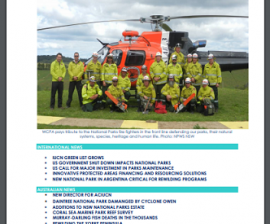
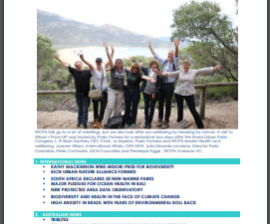
The first edition of the Newsletter of the IUCN World Commission on Protected Areas Oceania (2019). IUCN's World Commission on Protected Areas (WCPA) is the world's premier network of protected area expertise.
The fourth edition of the Newsletter of the IUCN World Commission on Protected Areas Oceania (2018). IUCN's World Commission on Protected Areas (WCPA) is the world's premier network of protected area expertise.
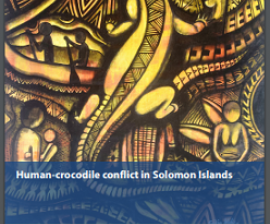
In 2017, following growing public concerns about saltwater crocodile attacks on people, the Ministry of Environment, Climate Change, Disaster Management and Meteorology (MECDM), the Ministry of Fisheries and Marine Resources (MFMR) and WorldFish conducted a nationwide survey to collect detailed i
The persistent, non-native invasive alga Gracilaria salicornia has dominated the protected waters surrounding Moku o Loʻe, Kāneʻohe Bay since its introduction in 1978; however, a sudden decline in abundance (75%) occurred within a 30-day survey period.
An increasing number of international initiatives aim to reconcile development with conservation. Crucial to successful implementation of these initiatives is a comprehensive understanding of the current ecological condition of landscapes and their spatial distributions.