In this article, I explore the knowledge and values that allowed the people of Oceania to develop sustainable use of their marine resources, followed by the demise of these systems after western colonization and the breakdown of traditional societies.
This study identifies the importance of: acquiring robust baseline data, being fully protected (no-take), using ecosystembased management, community inclusion, and of adopting an ecologically connected network approach.
These Environmental Impact Assessment Guidelines for Coastal Tourism Development in Pacific Island Countries and Territories (Guidelines) represent a sector specific version of SPREP’s regional EIA Guidelines first published in 1993 and recently expanded and updated in 2016.
Palau has a rich heritage of conservation that has evolved from the traditional moratoria on fishing, or “bul”, to more western Marine Protected Areas (MPAs), while still retaining elements of customary management and tenure.
Our rapidly warming climate is threatening coral reefs as thermal anomalies trigger mass coral bleaching events. Deep (or “mesophotic”) coral reefs are hypothesised to act as major ecological refuges from mass bleaching, but empirical assessments are limited.
This report of 220 pages written by nearly 90 authors clearly presents the summation of an enormous amount of data and information on 19 of the 23 nations and states of the Pacific and outlines both the problems and stresses on these thousands of reefs, and the potential that these reefs will pro
The Secretariat of the Pacific Regional Environment Programme (SPREP) presents these guidelines for undertaking rapid biodiversity assessments in its Pacific island member countries and territories: Micronesia, Melanesia, and Polynesia. These assessments are referred to as BIORAPs.
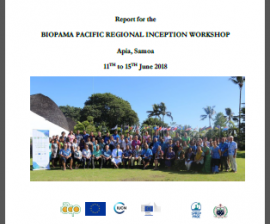
To formally launch the second phase of the Biodiversity and Protected Areas Management (BIOPAMA) programme, a regional inception workshop for the Pacific was held at the Tanoa Tusitala Hotel, Apia, Samoa from 11th to 15th June 2018.