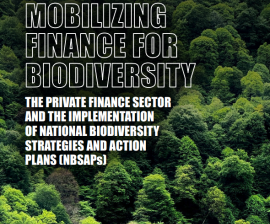
This guide aims to help businesses navigate the rapidly evolving voluntary biodiversity credit (VBC) markets and decide whether and how to engage in VBCs.
Aim: To present a short, practical guide to integrate climate change mitigation (CCM) into Protected and Conserved Area (PCA) management and decision-making and as a companion to the WCPA technical report Enhancing climate change mitigation in protected areas.
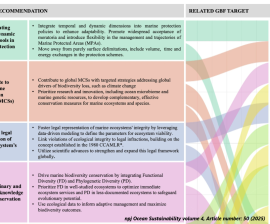
Marine ecosystems face threats from human-induced stressors like climate change, pollution, and habitat loss. Despite international endeavors, significant gaps remain in understanding ocean dynamics.
Acknowledging the diversity of forest contexts and the need for tailored approaches, this chapter examines the policy instruments that can operationalize a differentiated forest-climate agenda to achieve conservation and restoration outcomes.
The Kunming-Montréal Global Biodiversity Framework (GBF) recognizes that durable conservation outcomes cannot be achieved without the rights, leadership, and knowledge of Indigenous Peoples, Afro-descendant Peoples, and local communities.
Nature is the foundation of life on Earth, underpinning the ecosystem services that sustain societies and economies. Yet, its degradation continues at an alarming rate, threatening planetary resilience and human well-being.
We review the taxonomy, biology, and the ecological, economic, and human health impacts of the giant African snail, Lissachatina fulica, in the Pacific. Invasion of L. fulica in the Pacific has a complex history. Rapid population expansions of L.