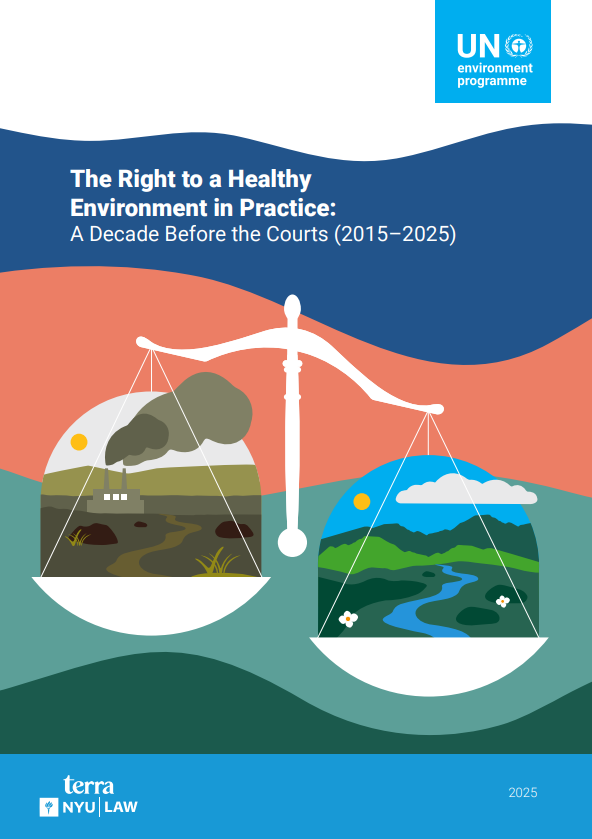
Since its initial articulation in the early 1970s, the sphere of legislative and judicial practices regarding the right to a healthy environment (R2HE) has evolved substantially. This report identifies and examines trends and developments in the interpretation of the R2HE over a decade (2015–2025) through an analysis of the advancement of the right in thirty jurisdictions, including international and regional human rights bodies.
This report is accompanied by the R2HE Toolkit, the first-ever database charting over one hundred real-world examples of the recognition of the global R2HE and caselaw analysis. The report primarily identifies four key trends that have emerged over the last decade:
(1) The mutually reinforcing recognition and jurisprudential development of the R2HE: The recognition of the R2HE by twelve additional countries over the last decade, coupled with the Escazú Agreement, has provided a renewed impetus for domestic and regional courts, as well as quasi-judicial mechanisms, to leverage the right’s international recognition for enforcement in their respective jurisdictions.
(2) The expansion of the R2HE’s scope and content: Embedded in the international consensus achieved through the Paris Agreement, courts have reaffirmed the centrality of the climate system for the recognition and sustenance of the R2HE. The normative interpretation of the right has also proven instrumental in shifting the trends of judicial reasoning toward more ecocentric perspectives.
(3) The employment of the R2HE by new actors: Through an emphasis on the intergenerational equity principle and recognition of State responsibility toward those not yet born, the use of the R2HE has expanded beyond traditional actors to include children and youth. With governments also utilizing the right as a defense and justification for enforcing their environmental obligations, an interesting, counterbalanced approach toward the application of the right has also been observed.
(4) The use of the R2HE to relax access to justice criteria: With the aid of many doctrinal and statutory tools, courts have utilized the R2HE as a central justification for expanding access to justice and challenging traditional notions of standing to access justice through legal processes.
Building on these ongoing trends, this report also highlights three additional signals of change that could gain legal relevance and visibility in the years ahead: first, the potential transition of the R2HE from a third-generation right to customary international law or jus cogens; second, the application of the R2HE in new ecological and legal contexts, such as ocean ecosystems and migration and displacement; and third, the harmonization of the R2HE and economic considerations by assigning greater weight to environmental protection.
This analysis of over one hundred judicial decisions underscores that the scope of the R2HE is well established in law and its interpretations, while continuing to undergo transformation. As we navigate the three planetary environmental crises of climate change, nature, land, and biodiversity loss, and pollution and waste, the R2HE will remain an important legal instrument—not only for addressing present harms but also for guiding efforts to
protect the future.

United Nations Environment Programme (2025). The Right to a Healthy Environment in Practice: A Decade Before the Courts (2015–2025). Nairobi. https://wedocs.unep.org/20.500.11822/48696.