  • SPREP Home
  • Protected Areas
SPREP Home
Log in
Search
Home | PIPAP - Supporting the sustainable management of protected areas in the Pacific Region.
  • Data
    • Protected Areas
    • Management Effectiveness Dashboard
    • Spatial Data
  • Assistance
    • How SPREP Helps
    • WDPA Protected Area Registration
    • Protected Area Working Group
  • Resource Hub
    • Publications
    • Decision Making Support Tools
    • Case Studies
  • Newsletter
    • Browse Newsletter Archive
    • Subscribe Now
  • Account
    • Login

Main menu

  • Data
  • Assistance
  • Resource Hub
  • Newsletter
  • Account

Breadcrumb

  1. Home
  2. Resource Hub
  3. Publications

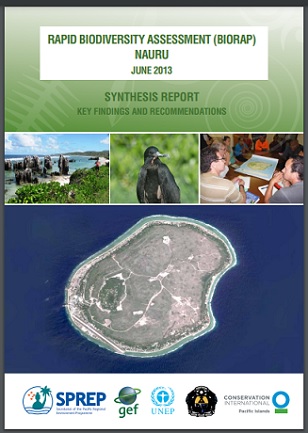
Rapid Biodiversity Assessment (BIORAP), Nauru. June 2013 - Synthesis Report

A BIORAP is a biological inventory programme undertaken in marine and terrestrial environments, and is designed to rapidly assess the biodiversity of highly diverse areas. Options to manage threats and protect some remaining examples of indigenous biodiversity of national or international significance are recommended to governing communities.The Nauru BIORAP took place in selected terrestrial and marine areas of the Republic of Nauru during 17–27 June, 2013. The key finding of the Nauru BIORAP are presented in this synthesis report.


Full Synthesis Report (Pdf)

Publication
Related page category(s)
Conservation Processes
Protected Area Network Design
Local Knowledge And Cultural
Data Analysis And Interpretation
Invasive Species
Marine Resources
Site Assessment Reports
Progress Towards Protected Area Targets
Related Pages
2026 State of the World's Sea Turtles (SWOT) Report
Nine changes needed to deliver a radical transformation in biodiversity measurement
Pacific coral reef monitoring assessment
The ocean’s enforcement gap
OECMs in Wetlands: Linkages with the Ramsar Convention
From entry into force to early implementation: Environmental Impact Assessments under the BBNJ Agreement
Coral microbiomes as reservoirs of unknown genomic and biosynthetic diversity
A practical, adaptive compliance management framework for improving marine protected area effectiveness
The hidden cost of fisheries subsidies
Why saving seagrass meadows could help save the world’s coastlines

Latest News

CMS
Decline of populations of migratory species alarms Pacific delegates at…
March 27, 2026 by Isaac Rounds
Read More
Sea Turtles
Sea Turtles and Tradition in the Pacific Islands
March 27, 2026 by Isaac Rounds
Read More
Palau
Developing a national loss and damage mapping and modalities framework for…
March 26, 2026 by Isaac Rounds
Read More
Blue Carbon
Coastal conservation has to work for local communities, study finds
March 25, 2026 by Isaac Rounds
Read More

Latest Resources

2026 State of the World's Sea Turtles (SWOT) Report
March 27, 2026 by Isaac Rounds
Read More
Nine changes needed to deliver a radical transformation in biodiversity…
March 27, 2026 by Isaac Rounds
Read More
Pacific coral reef monitoring assessment
March 27, 2026 by Isaac Rounds
Read More
The ocean’s enforcement gap
March 27, 2026 by Isaac Rounds
Read More
Biodiversity and Protected Areas Management Programme Logo Organisation of African, Caribbean and Pacific States Logo Sprep BioScapes Logo Flag of European Union International Union for Conservation of Nature Logo European Commission Logo

SPREP Footer Logo

A resilient Pacific environment sustaining our livelihoods and natural heritage in harmony with our cultures.

+685 21929
sprep@sprep.org

  • SPREP on Facebook
  • SPREP on YouTube
  • SPREP on Twitter
Protected Areas by Country
  • American Samoa
  • Cook Islands
  • Fiji
  • French Polynesia
  • Guam
  • Kiribati
  • Marshall Islands
  • Micronesia (Federated States of)
  • Nauru
  • New Caledonia
  • Niue
  • Northern Mariana Islands
  • Palau
  • Papua New Guinea
  • Samoa
  • Solomon Islands
  • Timor-Leste
  • Tokelau
  • Tonga
  • Tuvalu
  • Vanuatu
  • Wallis and Futuna
SPREP © 2026. All rights reserved.