Federated States of Micronesia's (FSM) nationally determined contributions (NDCs) 3.0 reflects its longstanding record of climate leadership. FMS's NDC 3.0 demonstrates both urgency and ambition.
The purpose of this Biodiversity Strategy and Action Plan (BSAP) is to Assist the Marshall Islands to Plan for the Conservation of its biodiversity and for in the sustainable use of its biological resources.
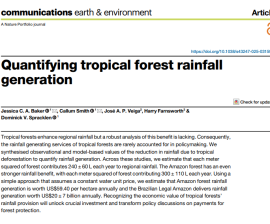
Tropical forests enhance regional rainfall but a robust analysis of this benefit is lacking. Consequently, the rainfall generating services of tropical forests are rarely accounted for in policymaking.
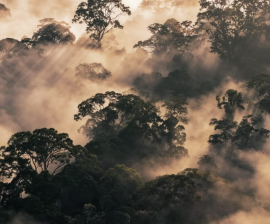
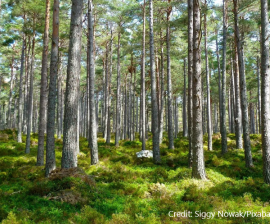
For decades, a dominant argument for protecting forests has focused on carbon. Trees absorb carbon dioxide, store it in wood and soils, and slow the accumulation of greenhouse gases. A new scientific review suggests this emphasis overlooks other ways forests shape climate and human well-being.
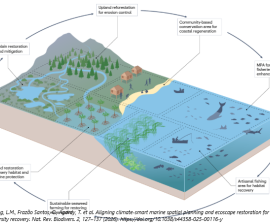
Meeting the ambitious targets set by the Convention on Biological Diversity (CBD) Kunming-Montreal Global Biodiversity Framework (GBF) will require expanding ecosystem restoration across governance domains for marine and coastal ecosystems.
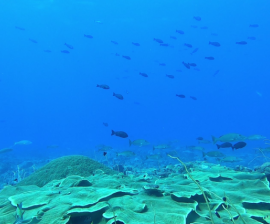
Since 2023, the Palau International Coral Reef Center (PICRC) has been collaborating with the Koror State Government (KSG) to conduct research and monitoring aimed at providing essential baseline data to guide the Koror Southern Lagoon Coastal Fisheries Management Plan, a new fisheries management
The interlinked crises of climate change and biodiversity loss are slipping down political agendas just as geopolitical instability and fiscal pressures rise.
Mangroves are trees and shrubs that grow in saline and brackish tidal waters across tropical and subtropical regions of the world.1Mangroves support rich biodiversity spanning both marine and terrestrial environments.
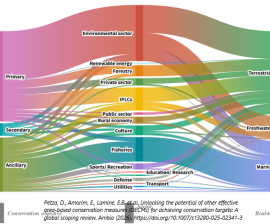
Other Effective Area-based Conservation Measures (OECMs), introduced by the Convention on Biological Diversity (CBD), refer to areas outside formal protected-area networks that deliver effective and enduring in situ biodiversity conservation.
Nurturing people-nature relationships in evolving social-ecological landscapes can slow biodiversity loss and build resilient communitiesBiodiversity loss is often framed as a failure of conservation. In reality, it is a failure of relationships.