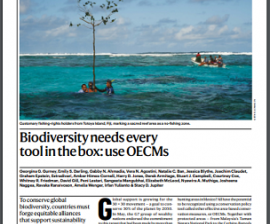
Global support is growing for the 30 × 30 movement — a goal to conserve 30% of the planet by 2030. In May, the G7 group of wealthy nations endorsed the commitment to this target that had been made by more than 50 countries in January.
The knowledge systems and practices of Indigenous Peoples and local communities play critical roles in safeguarding the biological and cultural diversity of our planet.
More than 15% of global terrestrial area is under some form of protection and there is a growing impetus to increase this coverage to 30% by 2030. But not all protection is effective and the reasons some countries’ protected areas (PAs) are more effective than others’ are poorly understood.
The Milne Bay Region of southeasternmost Papua New Guinea comprises a small portion of mainland New Guinea and several offshore islands, totaling 15,000 km2 in land area.
In 2018, the Parties to the Convention on Biological Diversity (CBD) adopted a decision on protected areas and other effective area-based conservation measures (OECMs).
Fijians have been at the forefront of ocean action and leadership because it i our responsibility as an oceanic people. Fiji is a nation of over 300 islands whose past, present and future are intrinsically linked to the ocean.
As environmental problems continue to increase at an ever more rapid rate, exacerbated by the major threat of global climate change, the need for widespread remedial action is becoming ever more pressing.