United Nations General Assembly Resolution 69/292 has committed States to develop an international legally binding instrument under the 1982 United Nations Convention on the Law of the Sea on the conservation and sustainable use of marine biological diversity of areas beyond national jurisdiction
Corals and coral-associated species are highly vulnerable to the emerging effects of global climate change. The widespread degradation of coral reefs, which will be accelerated by climate change, jeopardizes the goods and services that tropical nations derive from reef ecosystems.
Climate change will impact coral-reef fishes through effects on individual performance, trophic linkages, recruitment dynamics, population connectivity and other ecosystem processes.
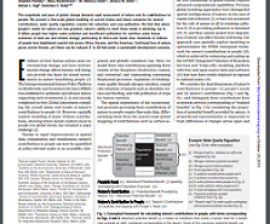
The magnitude and pace of global change demand rapid assessment of nature and its contributions to people. We present a fine-scale global modeling of current status and future scenarios for several contributions: water quality regulation, coastal risk reduction, and crop pollination.
The Great Barrier Reef is internationally recognised for its natural and heritage value. Australian Government established the Great Barrier Reef Marine Park under the Great Barrier Reef Marine Park Act, 1975.
Good governance is fundamental to effective protected area (PA) design, planning, and management operations, and the degree to which these are equitable in terms of the recognition and engagement of key actors, and the distribution of benefits and costs/burdens.
Formal education at the regional University of the South Pacific (USP) needs to continue to evolve in order to prepare students from Pacific Island countries (PICs) to meet future challenges as ocean managers.
Biodiversity offsets (BO) are increasingly promoted and adopted by governments and companies worldwide as a policy instrument to compensate for biodiversity losses from infrastructure development projects. To provide a framing for understanding the empirical diversity of BO policy designs, w
Bleaching and disease are decimating coral reefs especially when warming promotes bleaching pathogens, such as Vibrio coralliilyticus. We demonstrate that sterilized washes from three common corals suppress V.