For more than 40 years, marine zoning has played a key role while evolving as part of the adaptive management of the Great Barrier Reef (GBR) Marine Park.
Converting assemblages of marine protected areas (MPAs) into functional MPA networks requires political will, multidisciplinary information, coordinated action and time.
Evaluation, the process of assessing the effectiveness of programs and activities, has gained increasing attention in the conservation sector as programs seek to account for investments, measure their impacts, and adapt interventions to improve future outcomes.
One-sixth of the global terrestrial surface now falls within protected areas (PAs), making it essential to understand how far they mitigate the increasing pressures on nature which characterize the Anthropocene.
In June 5–9, 2017, during the United Nations (UN) Ocean Conference, 143 governments, signatory parties of the Convention on Biological Diversity (CBD) declared their commitment and strategies to reach several objectives of the Sustainable Development Goal (SDG) 14, which stands to “conserve and s
Coral reefs are one of the world’s most biologically diverse and productive ecosystems. However, these valuable resources are highly threatened by human activities.
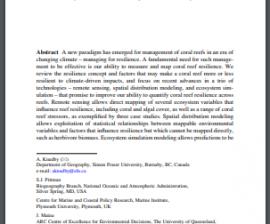
A new paradigm has emerged for management of coral reefs in an era of changing climate – managing for resilience. A fundamental need for such management to be effective is our ability to measure and map coral reef resilience.