We report three major and confronting environmental issues that have received little attention and require urgent action. First, we review the evidence that future environmental conditions will be far more dangerous than currently believed.
Gender equality is a mainstream principle of good environmental governance and sustainable development. Progress toward gender equality in the fisheries sector is critical for effective and equitable development outcomes in coastal countries.
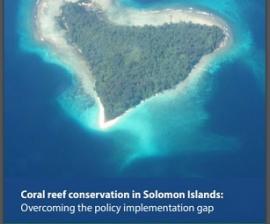
This policy gap analysis identifies threats to coral reefs, evaluates the effectiveness of the existing legal framework to address these threats, and formulates recommendations to strengthen community-based natural resource management in Solomon Islands.
Effective networks of marine protected areas (MPAs) are explicitly recognized and called for in international biodiversity conservation strategies such as the Aichi Targets.
IUCN World Heritage Outlook 3 builds on three cycles of Conservation Outlook Assessments undertaken since 2014. It presents the main results for 2020, but also some longer-term trends based on a comparison of three data sets now available.
Community-based management and co-management are mainstream approaches to marine conservation and sustainable resource management. In the tropical Pacific, these approaches have proliferated through locally-managed marine areas (LMMAs).
The conservation, rehabilitation and climate-informed management of biodiversity and ecosystems increases resilience to climate change and provides low-cost and long-term solutions to protect lives, livelihoods and infrastructure, and advance progress toward the Sustainable Development Goals.
Natural habitats have the ability to protect coastal communities against the impacts of waves and storms, yet it is unclear how different habitats complement each other to reduce those impacts.
Coastal ecosystems and the services they provide are adversely affected by a wide variety of human activities. In particular, seagrass meadows are negatively affected by impacts accruing from the billion or more people who live within 50 km of them.