This guide has been developed to improve catch and landings data on sharks and rays that are listed on three international treaties, the Convention on the Conservation of Migratory Species of Wild Animals (CMS).
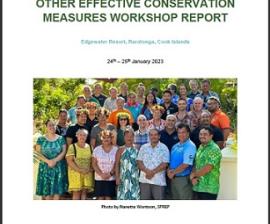
The CKI OECM Workshop Report consolidates the discussions, outcomes, recommendations and next steps following the Other Effective Area-based Conservation Measures Workshop, hosted by the National Environment Service, in partnership with Secretariat of Pacific Regional Environment Program and
This document identifies the most effective options for delivery of a target of achieving 30% of land and of ocean in protected areas and other effective area-based conservation measures by 2030 (30x30), as set out in the draft Target 3 of the Global Biodiversity Framework (GBF) form the Conventi
Tuna biomass (skipjack and bigeye tuna) variability over the period 1998-2019 simulated by the Spatial Ecosystem and Population Dynamics Model (SEAPODYM). Here, we provide the unfished biomass dynamics (i.e. without considering any fishing).
Sharks and rays are key functional components of coral reef ecosystems, yet many populations of a few species exhibit signs of depletion and local extinctions. The question is whether these declines forewarn of a global extinction crisis.
Many protected areas worldwide increasingly resemble habitat isolates embedded in human-modifed landscapes. However, establishing linkages among protected areas could signifcantly reduce speciesloss rates.
The first part of the UN Biodiversity Conference convened virtually from 11-15 October 2021, with a limited number of delegates physically present in Kunming, China.
Islands support unique plants, animals, and human societies found nowhere else on the Earth. Local and global stressors threaten the persistence of island ecosystems, with invasive species being among the most damaging, yet solvable, stressors.
Even optimistic climate scenarios predict catastrophic consequences for coral reef ecosystems by 2100. Understanding how reef connectivity, biodiversity and resilience are shaped by climate variability would improve chances to establish sustainable management practices.